When it comes to the world of venous health, there is often a great deal of confusion regarding what is considered “medical” and what is considered “cosmetic.” To clear the air, let’s start with the basics of Veins 101.
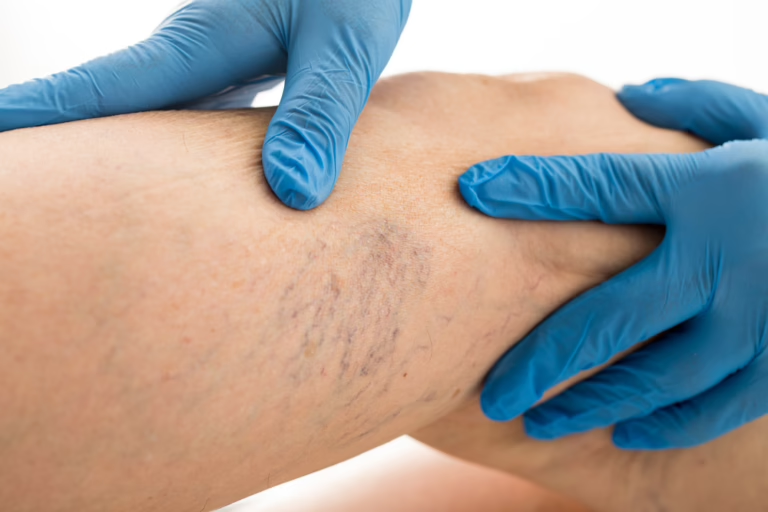
Varicose veins are those large, ropey vessels that bulge noticeably above the surface of the skin. They are thick, often twisted, and can look like cords running down the leg. Spider veins, on the other hand, are the thin, thread-like veins that lie just below the surface. They often look like a sunburst or a spider web, hence the name, and while they can be vibrant red, blue, or purple, they do not bulge.
While both involve the venous system, insurance companies view them as two entirely different worlds. Understanding these nuances is the key to managing your leg health and your wallet.
The Medical Reality of Varicose Veins
Varicose veins are more than just an eyesore; they can be genuinely nasty. Because they represent a failure in the circulatory system (venous insufficiency), they lead to a host of physical symptoms that can significantly impact your quality of life.
Potential Complications of Varicose Veins:
- Physical Pain: Aching, throbbing, and a “heavy” feeling in the legs that worsens by the end of the day.
- Restless Legs: That uncontrollable urge to move your legs at night, often disrupting sleep.
- Swelling (Edema): Fluid buildup around the ankles and calves.
- Venous Ulcers: Open sores that are slow to heal, usually occurring near the ankle.
- Blood Clots: In the worst-case scenario, stagnant blood in these veins can form a clot (Deep Vein Thrombosis or Superficial Thrombophlebitis). If these clots break loose, they can travel to the heart or lungs; a life-threatening complication.
Because of these risks, varicose veins are considered a medical problem. At least in theory, insurance should pay for their treatment if certain criteria are met.
The Cosmetic Classification of Spider Veins
Now, here is the rub. While spider veins can look “ugly”, they rarely lead to the dangerous medical complications mentioned above. They don’t typically cause ulcers or life-threatening clots.
To an insurance company, spider veins are strictly a cosmetic problem. From their perspective, paying to remove spider veins is the same as paying for a nose job, a facelift, or breast augmentation. Their stance is firm: Insurance does not pay for cosmetic treatments.
And with that, we’ve largely finished the discussion about direct insurance coverage for spider vein treatment in Newington. There is essentially none. However, there is a “silver lining” that many patients overlook.
The Hidden Connection: When “Cosmetic” Meets “Medical”
Before you give up hope, you should know that spider veins don’t always act alone. Often, those little purple webs are actually “feeder veins” arising from deeper, underlying varicose veins that you might not even see yet.
If you have underlying venous insufficiency (varicose vein disease), treating the “source” of the problem is medically necessary. At Vanishing Veins, we often find that when we treat the larger, underlying medical issue using Radiofrequency Ablation (RFA) or Closure™, the associated spider veins may diminish or even disappear as the pressure in the leg is reduced.
This is why a professional evaluation with Dr. Lori Greenwald is so vital. We don’t just look at the surface; we use diagnostic ultrasound in our accredited lab to see what is happening underneath. If there is a medical cause for your spider veins, we may be able to secure insurance coverage for the foundational treatment.
Making Treatment Affordable: The Vanishing Veins Approach
What’s a girl (or guy!) to do if the problem is purely cosmetic? At Vanishing Veins, we believe that everyone deserves to feel confident in their skin, regardless of insurance technicalities. We have developed several alternatives to make sure you can afford the clear, beautiful legs you want.
1. The Vanishing Veins Easy Payment Plan
If your treatment requires three or more sessions, which is the case for most patients to achieve optimal results, we offer an in-house payment plan. You can split your total cost over three monthly payments with a small, flat finance fee of only 5%. This allows you to start your transformation without a large upfront burden.
2. CareCredit Financing
We offer CareCredit right in our office. You can even apply and be approved while you are checking out. CareCredit is a credit card specifically designed for health and wellness expenses. They offer various promotional financing options, frequently including 0% interest for 6 to 18 months, depending on the plan. This is an excellent way to fit your “leg makeover” into your monthly budget.
3. Our Exclusive “Special Offers”
Once or twice a year, we run a special that our patients rave about: four spider vein sessions for $999. This represents a savings of roughly one-third off our standard pricing. These specials aren’t on a fixed schedule, so the best way to catch them is by joining our email list and reading our monthly newsletter.
Expertise You Can Trust: Sclerotherapy and Beyond
When you choose Vanishing Veins for your cosmetic treatments, you aren’t just getting a “quick fix” at a med-spa. You are receiving care from a team led by a board-certified vascular surgeon.
Our primary tool for spider vein treatment in Glastonbury is sclerotherapy. During this procedure, a specialized solution is injected into the tiny veins, causing them to close and eventually be reabsorbed by the body. Because we understand the “Expertise of a Surgeon” and the “Touch of a Woman,” we perform these injections with precision and care, minimizing discomfort and maximizing results.
Our Services Include:
- Diagnostic Mapping: To make sure your spider veins aren’t a symptom of a deeper problem.
- Cosmetic Sclerotherapy: Custom sessions to clear away thread veins.
- Radiofrequency Ablation (RFA): To treat the underlying “medical” cause of leg pain.
- Microphlebectomy: To remove bulging veins through tiny, hidden incisions.
The Good, The Bad, and The Beautiful
So, that’s the breakdown: the bad (spider veins), the ugly (insurance won’t pay for them), and the good (Vanishing Veins makes it easy and affordable to get the treatment you deserve).
Don’t let insurance companies dictate how you feel about your legs. Whether your condition is a medical necessity or a cosmetic goal, Dr. Greenwald and her expert staff are here to guide you through every step of the process, from the first ultrasound to the final sclerotherapy session.
Are you ready to say goodbye to your spider veins? Contact us to schedule your consultation or call us at 860-761-6666. Dr. G is ready to help you get back to wearing shorts with confidence!
This post was updated 2/19/26.