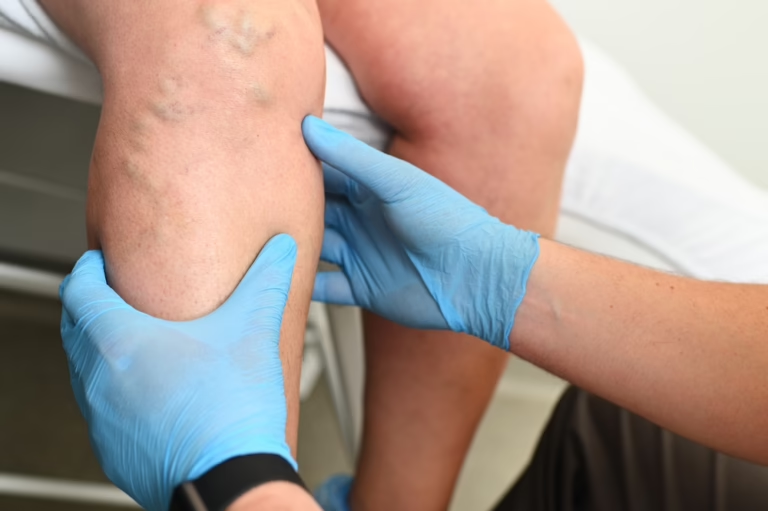
You’ve noticed the symptoms. Perhaps your legs feel heavy and leaden by the end of the day, or there is a persistent ache that only resolves when you put your feet up. Maybe you’ve spotted a cluster of spider veins or a bulging rope-like vessel that wasn’t there a year ago. Naturally, you decide to see a vein specialist to find out if you have vein disease. You want answers, and more importantly, you want relief.
In my previous article, “Beware of Fake Ultrasounds,” I pulled back the curtain on how some unscrupulous “vein centers” manipulate patients by making them stand for an hour during a scan. This “stress test” eventually forces even healthy valves to fail, creating a “positive” result out of thin air.
Today, I want to expose an even more common, and arguably more deceptive, tactic: the horizontal ultrasound. To understand why this matters, we have to look at the physics of your blood and the ethics of medical diagnostics.
Why a “Positive” Ultrasound is the “Golden Ticket” for Clinics
Before we dive into the mechanics of the scam, you need to understand the motivation. In the world of modern medicine, an ultrasound showing venous reflux is the “Golden Ticket.” It is the specific clinical criterion required by insurance companies to justify and reimburse a vein procedure.
These procedures are highly lucrative, often billing between $4,000 and $6,000 per leg. If a clinic can “find” reflux in both of your legs, they have just secured a five-figure payday. This creates a massive financial incentive for high-volume “vein mills” to make sure every patient who walks through the door leaves with a positive diagnosis.
The Physics of Blood: How Gravity Closes Your Valves
To grasp how a doctor can fake a diagnosis while you are lying down, we have to revisit basic anatomy. Your leg veins contain tiny, one-way leaflets called valves. Their sole job is to fight gravity.
When you are standing, gravity pulls a column of blood downward toward your feet. This downward pressure is actually what catches the leaflets of the valves and snaps them shut, preventing blood from pooling in your ankles. Think of it like a trapdoor that only stays shut because someone is pushing against it from the outside.
What Happens When You Lie Down?
When you lie down on an examination table, the game changes entirely:
- Gravity is Neutralized: Since your legs are horizontal, gravity is no longer pulling the blood toward your feet.
- Valves Stay Open: Because there is no downward pressure to “snap” the valves shut, the leaflets simply float in a neutral, open position.
- Artificial Reflux: If a technician performs an ultrasound while you are lying flat, the blood can easily flow “backward” because the valves aren’t engaged.
If a clinic performs the test while you are lying down but fraudulently reports to the insurance company that you were standing, they have successfully manufactured a “positive” result for a procedure you likely do not need.
The Vanishing Veins Standard: Integrity in Diagnostics
At Vanishing Veins, we refuse to participate in these diagnostic games. Our vein specialists in Tolland follow the strict protocols established by national vascular organizations, which mandate that venous insufficiency must be assessed with the patient in a standing or steeply tilted position.
We believe that medical care should be a partnership based on trust, not a sales transaction. When we perform an ultrasound, we are looking for the truth of your vascular health, not a reason to bill your insurance.
Our Suite of Services
When a diagnosis is actually warranted, we offer the most advanced, minimally invasive treatments available today. Our expertise includes:
- Radiofrequency Ablation (RFA): A sophisticated, heat-based procedure where a small catheter uses radiofrequency energy to seal a diseased vein. This redirects blood flow to healthy vessels, drastically reducing symptoms with minimal downtime.
- Sclerotherapy: The gold standard for treating spider veins and smaller varicose veins by injecting a solution that causes the vein to safely fade away.
- Microphlebectomy: A specialized technique for removing large, bulging surface veins through tiny incisions that require no stitches and leave virtually no scarring.
- Conservative Therapy Management: We help patients navigate compression therapy and lifestyle modifications for those who do not yet require surgical intervention.
How to Spot a “Vein Mill” Before You Sign Up for Surgery
If you are visiting a vein center in Farmington for the first time, you have the right to be an informed consumer. Your health, and your wallet, depend on it. Watch out for these three major red flags:
1. The “Horizontal” Exam
If the technician performs the entire reflux ultrasound while you are lying flat on your back, red flag. A legitimate test for venous insufficiency requires the stress of gravity to see if your valves are actually failing under normal daily conditions.
2. The Missing “Valsalva” or “Calf Squeeze”
During a proper ultrasound, the technician should either have you perform a “Valsalva maneuver” (bearing down as if lifting something heavy) or they should manually squeeze your calf. This is done to purposefully push blood up and see if the valves catch it on the way back down. If they are just gliding the probe over your leg while you rest, they aren’t getting a real picture.
3. The “Free Screening” Bait-and-Switch
Be wary of “free screenings” at health fairs or community centers. These are often used as lead-generation tools. If every person who gets a “free” scan is told they need a $5,000 procedure, the math simply doesn’t add up.
Why Expert Certification Matters
Venous medicine has seen an explosion of “specialists” lately, many of whom were practicing entirely different types of medicine just a few years ago. At Vanishing Veins, our expertise isn’t just a marketing slogan; it is backed by years of specialized vascular focus.
We utilize Registered Vascular Technologists (RVTs) who specialize specifically in the nuances of leg veins. Interpreting an ultrasound is an art as much as a science, and it requires a dedicated professional to distinguish between a healthy valve and one that is truly diseased.
The Bottom Line: I may make less money by refusing to “find” reflux in every patient, but I can sleep at night knowing that every procedure I perform is medically necessary and truly beneficial to my patients’ lives.
Your Next Steps: Getting a Second Opinion
If you’ve been told you need a vein procedure but something feels “off”, perhaps the ultrasound felt rushed, or you were lying down the whole time, it is worth your time to seek a second opinion.
A false diagnosis doesn’t just cost money; it involves an unnecessary medical procedure on your body. You deserve a team that prioritizes your health over their bottom line, contact us today to get the care you really need.
This post was updated 2/19/26.