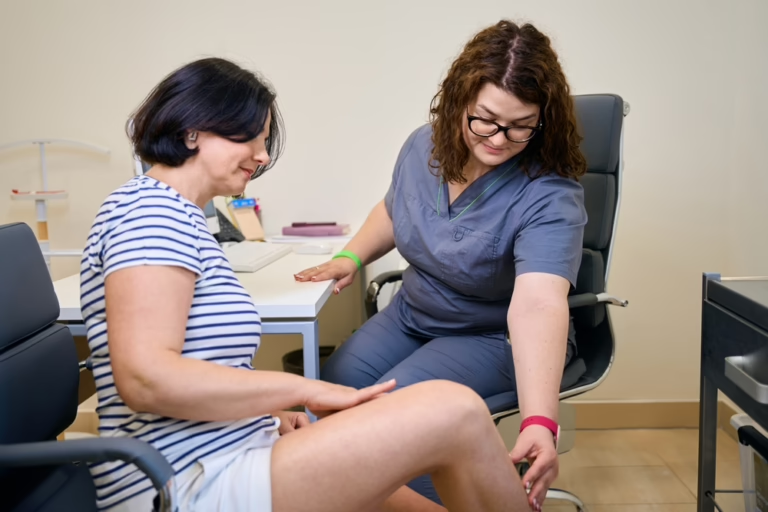
Lately, I’ve been seeing a significant rash of patients coming to our office for second opinions. Many of these individuals share a similar, troubling story: they visited another “vein center,” underwent an ultrasound, and were told they had a “positive” result; meaning they supposedly needed an invasive procedure.
However, when we perform the same ultrasound at Vanishing Veins, the results are often negative. Understandably, the patient is confused, frustrated, and often a bit scared. Who is right? How can one medical center claim your veins are failing while another says you are perfectly healthy? Even more concerning, some patients have an ultrasound performed on a symptomatic leg, only for the technician to scan the healthy leg “just for good measure” and tell the patient that the non-symptomatic leg needs surgery too.
To clear up this confusion, we need to pull back the curtain on how vein centers operate and look at the actual science of how your blood moves.
The Ingenious Anatomy of Your Legs
To understand why a diagnosis can be manipulated, you first have to understand the “uphill battle” your body fights every day. Getting blood from your toes back up to your heart is a defiance of gravity. Because gravity is constantly trying to pull blood down toward the pavement, your body has evolved an ingenious two-part system to keep things moving.
1. The Calf Muscle Pump
Think of your calf muscles as a “second heart.” As you walk and move throughout the day, your leg muscles contract and massage the deep veins. This action provides a propulsive force that squirts blood upward toward the torso.
2. The One-Way Valves
Imagine a bit of blood near the ankle. When your muscle pushes it up to the calf, gravity wants to drag it back down the moment the muscle relaxes. To prevent this, your veins are lined with tiny, one-way valves. These valves open to let blood pass through from below and then snap shut to prevent it from leaking backward. This process repeats, segment by segment, until the blood leaves the leg above the groin.
Defining Venous Insufficiency and Reflux
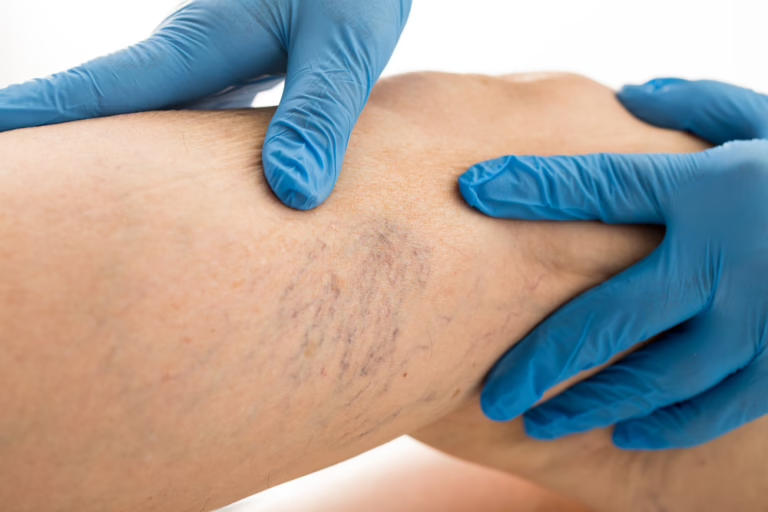
When these valves fail to close properly, the system breaks down. This condition is known as venous insufficiency or venous reflux. Instead of moving toward the heart, blood “refluxes” or pools in the lower leg. This pooling increases pressure, eventually causing the veins to stretch and bulge until they are visible under the skin. This is the origin of the classic varicose vein.
However, the presence of a varicose vein is only one part of the story. The severity of the reflux is what determines whether a medical procedure is truly necessary.
The “Stress Test” Trap: Why Ultrasound Results Vary
When we assess a leg using ultrasound, we are essentially performing a stress test. We have the patient stand up because gravity is the ultimate antagonist to your valves. By standing still, there is no muscle pump to help the blood move; we are relying entirely on the valves to hold the weight of the blood column.
Here is where the ethics of vein care come into play.
If we “stress” the valves long enough, we can find reflux in almost anyone. Even the healthiest valves have a breaking point. If you stand perfectly still for an hour, your valves will eventually fatigue and allow some blood to leak backward.
The One-Hour Ultrasound Warning
Many patients who come to our vein clinic in Canton for a second opinion report that they were made to stand for a full 45 to 60 minutes during their initial evaluation elsewhere.
- The Problem: This is not a realistic assessment of human physiology.
- The Reality: In daily life, you rarely stand perfectly still for an hour. You are either walking (engaging the pump) or sitting/lying down (reducing the gravitational load).
- The Result: If a doctor has to stress your valves for an hour to find an “abnormality,” that abnormality isn’t actually causing your symptoms. It is a “false positive” designed to justify a procedure.
At Vanishing Veins, we believe 20 minutes is the gold standard. If your valves can’t hold up for 20 minutes of standing, you have a clinical issue that needs addressing. If they hold up for 20 but fail at 60, you are healthy.
The Vanishing Veins Difference: Expertise and Integrity
At Vanishing Veins, our philosophy is simple: We perform as many procedures as our patients need, not as many as we can. Our vein clinic in New Britain is built on specialized expertise and a commitment to honest diagnostics.
Why Choose Vanishing Veins?
- Specialized Focus: Unlike general surgery centers that do “a little bit of everything,” our focus is exclusively on vascular health and venous aesthetics.
- Accurate Diagnostics: Our ultrasound technicians are trained to identify clinically significant reflux. We don’t hunt for “borderline” issues to pad a schedule.
- Conservative First: We often recommend lifestyle changes, compression therapy, or exercise before jumping to surgical interventions.
- Patient Advocacy: Dr. Greenwald and the team take the time to explain the why behind your symptoms, making sure you aren’t just a number on a chart.
Red Flags to Watch For at Other Clinics
If you are seeking treatment for leg pain, swelling, or varicose veins, be on the lookout for these “vein mill” tactics:
- The “Both Legs” Upsell: If only one leg hurts but they insist on treating both, be skeptical.
- The Marathon Ultrasound: If you are standing for more than 30 minutes for a diagnostic scan, they may be trying to “force” a positive result.
- The Immediate Pressure: If a clinic pressures you into a procedure before explaining conservative options, seek a second opinion.
Conclusion: Say “Adios” to Dishonest Doctors
Your health is too important to be treated as a sales quota. A “positive” ultrasound should correlate with your actual physical symptoms. If you don’t have pain, heaviness, or significant swelling, but a doctor is telling you that you need a major procedure based on a grueling one-hour ultrasound, it’s time to walk away.
We pride ourselves on our transparency. Contact Vanishing Veins to get an honest assessment. If you need a procedure, we use the latest minimally invasive technology to get you back on your feet. If you don’t need one, we’ll be the first to tell you the good news.
This post was updated 2/19/26.