Did you know that vein disease is one of the most common chronic conditions in the United States? It is so prevalent that some clinical studies rank it as the leading cause of lost time from work; surpassing even many more “famous” ailments. Despite its frequency, many people view varicose veins as an inevitable part of aging or a mere cosmetic nuisance.
At Vanishing Veins, we want to change that narrative. Understanding why your veins are changing is the first step toward reclaiming your health. Under the leadership of Dr. Lori Greenwald, a board-certified vascular specialist, we focus on the root causes of vein disease to provide lasting relief for varicose veins in Windsor.
The Anatomy of a “Leaky” System: How Veins Fail
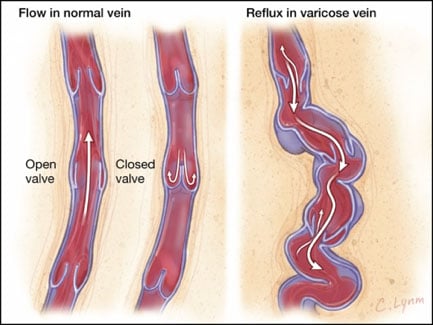
To understand why you get varicose veins, we have to look at the “plumbing” of the human body. Your heart is a magnificent pump that sends oxygenated blood all the way down to your toes. However, your feet don’t have a second heart to pump that blood back up.
Instead, your body relies on the calf muscle pump. When you walk, your leg muscles contract, squeezing the veins and pushing blood upward toward your heart. But there is a major obstacle: gravity. To prevent blood from rushing back down to your ankles between muscle contractions, your veins are equipped with hundreds of tiny, one-way valves.
The Moment Varicose Veins Begin
In a healthy leg, these valves act like swinging doors that only open upward. When the valve fails or becomes “leaky,” blood begins to flow backward (a condition called venous reflux). This pooling blood creates high pressure, causing the vein walls to stretch, twist, and bulge. Voila: you have a varicose vein.
The Gender Gap: Why Women Are at Higher Risk
Statistically, about 60% of Americans will suffer from some form of vein disorder by age 60. However, women are affected by a margin of two to one compared to men. Why is the deck stacked against women? The answer is largely hormonal.
The Estrogen Connection
Estrogen is a powerful hormone that, unfortunately, has a relaxing effect on the smooth muscle walls of your veins. When vein walls relax too much, they become “floppy,” making it much harder for the valves to meet in the middle and close properly.
The Pregnancy Cycle
Pregnancy is the most significant “trigger” for vein disease in women. During pregnancy, estrogen levels skyrocket, and the total volume of blood in the body increases by nearly 50%. This puts immense pressure on the pelvic and leg veins.
- The Vicious Cycle: After a first pregnancy, the valves may partially heal, but they are often left slightly damaged.
- Compounding Damage: During a second or third pregnancy, new damage occurs on top of the old. By the time a woman has had several children, her venous system has often sustained significant structural failure.
Occupational Hazards: Teachers, Nurses, and Firefighters
If your job requires you to stand or sit for hours at a time without moving, you are at a significantly higher risk for varicose veins. This is why our waiting room is often filled with dedicated professionals like teachers, firefighters, and retail workers.
When you stand still, your “calf muscle pump” is idle. The column of blood in your legs exerts constant, heavy downward pressure on those tiny valves. Over years of 8-hour shifts, that pressure eventually causes the valves to give way. It isn’t just a matter of being tired at the end of the day; it is a matter of mechanical wear and tear on your vascular system.
Age and Genetics: Factors We Can’t Change
While lifestyle plays a role, two factors are largely out of our control: time and DNA.
- The Aging Process: Like any mechanical part, your valves have a “shelf life.” Decades of fighting gravity eventually take their toll. The older we get, the less elastic our vein walls become, making valve failure more likely.
- Family History: Genetics is one of the strongest predictors of vein disease. If your mother or grandmother suffered from bulging veins or leg ulcers, your risk increases exponentially. You may have inherited “weaker” vein walls or fewer valves than the average person.
The Vanishing Veins Difference: Expertise and Care
If you recognize yourself in the descriptions above (if you’ve had children, work on your feet, or have a family history of vein issues) you shouldn’t wait for your symptoms to become debilitating.
Why Choose Dr. Lori Greenwald?
Treating veins requires more than just a laser; it requires an expert eye. Dr. Lori Greenwald is a Diplomate of the American Board of Venous and Lymphatic Medicine and a board-certified vascular surgeon. With over 17,000 procedures performed since 2003, she is one of the most experienced phlebologists in the region. She doesn’t just treat the “bulge”; she treats the underlying source of the reflux.
Our Services
We offer a full spectrum of treatments designed to be quick, effective, and minimally invasive:
- Radiofrequency Ablation (RFA): A gentle heat treatment that seals the “leaky” vein, rerouting blood to healthy ones.
- Microphlebectomy: Removing large, ropey veins through tiny punctures that require no stitches.
- Ultrasound-Guided Sclerotherapy: For treating “hidden” veins that are often the source of pain and skin changes.
- Cosmetic Spider Vein Treatment: To restore the aesthetic confidence you may have lost.
Take the Next Step Toward Healthy Legs
Varicose veins are a progressive medical condition. They do not get better on their own, but with modern technology, they are incredibly easy to treat. Most of our procedures are performed in under an hour, and you can walk right back to your normal life immediately afterward.
Don’t let your “leaky valves” keep you from the activities you love. Whether you are a teacher who is tired of aching legs or a mother looking for spider vein treatment in New Britain, Vanishing Veins is here to help.
Schedule Your Evaluation
Contact us today to book a consultation with Dr. Lori Greenwald. Experience the difference that board-certified expertise and compassionate care can make for your legs.
This post was updated 2/18/26.