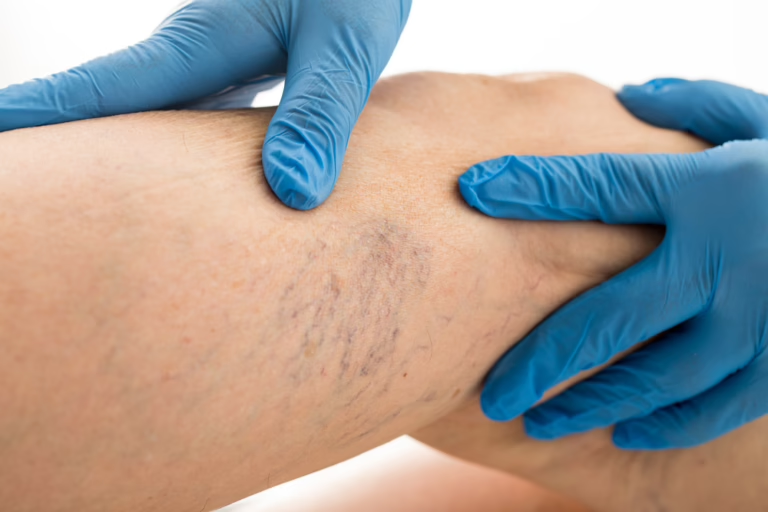
You’ve done everything by the book. You called your insurance company to confirm that varicose vein treatment is a covered benefit under your plan. You heard the “yes” you were looking for. You scheduled your evaluation with Dr. Lori Greenwald at Vanishing Veins, underwent a thorough diagnostic ultrasound, and worked with our team to develop a treatment plan to finally end the aching, heaviness, and swelling in your legs.
Then, the letter arrives in the mail: “We’re sorry, Mrs. Smith, but we don’t think treating your varicose veins is medically necessary, and we will not cover the recommended procedures.”
It feels like a punch in the gut. You’re in pain, your legs feel like lead, and a board-certified vascular surgeon has identified diseased veins; yet a claims adjuster behind a desk just told you “no.” While this doesn’t happen often at our practice, it is a scenario we are fully prepared to handle. Here is how the denial process works and, more importantly, how we fight to overturn it.
Why Do Insurance Companies Deny Claims?
To an insurance company, “coverage” and “payment” are two very different things. Your policy might state that vein treatments are a benefit, but the company will only pay if you meet their specific, and often rigid, “medical necessity” criteria.
During your examination at Vanishing Veins, we perform a detailed mapping of your venous system. We measure the diameter of your veins and use Doppler ultrasound to timing the “reflux” or backward flow of blood. However, every insurance provider has its own unique “rulebook.”
Common Reasons for Denial:
- Insufficient Reflux Time: The insurer may require blood to flow backward for at least 500ms (half a second), and if your test shows 450ms, they may deny it, even if you are in pain.
- Vein Diameter: Some companies won’t pay to treat a vein unless it reaches a specific size, regardless of the symptoms it causes.
- Documentation Gaps: If the “Trial of Conservative Management” (wearing compression stockings) wasn’t documented exactly to their liking, they will use it as grounds for a denial.
- Administrative Errors: Sometimes, a simple coding mismatch at the insurance headquarters triggers an automatic “no.”
The Vanishing Veins Advocacy Plan: Going to Bat for You
At Vanishing Veins, we don’t take “no” for an answer easily. Our vein specialists in Newington understand that your varicose veins aren’t just a cosmetic nuisance; they are a medical condition impacting your quality of life. When a denial letter hits our desk, our advocacy team kicks into high gear.
The Peer-to-Peer Review
This is our most powerful tool. When a claim is denied, Dr. Greenwald, one of America’s Top Surgeons, schedules a “Peer-to-Peer” review. This is a formal phone call between our physician and a medical director at the insurance company.
During this call, Dr. Greenwald speaks surgeon-to-surgeon. She moves past the automated algorithms and explains the nuances of your case:
- Clinical Presentation: She describes your specific symptoms; the night cramps, the skin changes, and the daily pain that limits your mobility.
- Ultrasound Review: She explains the technical data from our accredited vascular lab, highlighting why the measurements meet the spirit of the medical necessity guidelines.
- Quality of Life: She advocates for the long-term benefits of the procedure, such as preventing future blood clots or venous ulcers.
Often, this direct professional dialogue is enough to get the denial overturned on the spot.
Our Suite of Advanced Treatments
We fight so hard for these approvals because we know how transformative our treatments are. At Vanishing Veins, our vein doctors in Canton specialize in minimally invasive procedures that get you back to your life with virtually no downtime.
- Radiofrequency Ablation (RFA): Using thermal energy to safely seal the diseased “leaky” vein.
- Microphlebectomy: A specialized technique where Dr. Greenwald removes bulging surface veins through tiny, micro-incisions that don’t even require stitches.
- Sclerotherapy: The gold standard for closing smaller branch veins and spider veins, often used as a finishing touch to make sure your legs feel and look their best.
What If the Final Answer is Still “No”?
While we have a high success rate with appeals, occasionally an insurance company stands firm on a denial. Our goal remains the same: to get you feeling better. We don’t want you living with pain and tiredness simply because of an insurance technicality.
In the event of a final denial, we offer several flexible payment options and financing plans. Many patients find that the cost of the procedure is a worthwhile investment in their health, especially when compared to the years of co-pays, compression garments, and lost productivity caused by untreated vein disease.
The Vanishing Veins Difference
We provide the “Touch of a Woman and the Expertise of a Surgeon.” This means we treat you like a person, not a claim number. Our staff is highly trained in the “Insurance 101” of vein care, and we stay updated on the ever-changing policies of major carriers so we can navigate them for you.
Summary: You Aren’t Alone in the Fight
Navigating health care in 2026 is complex, but you don’t have to do it by yourself. If you receive a denial, remember:
- Don’t Panic: It is often just the beginning of the conversation, not the end.
- Trust the Process: Our team at Vanishing Veins handles these appeals daily.
- Stay Informed: Keep all your documentation regarding your “conservative trial” (compression stockings).
We want you to feel your best because that is what you deserve. We are committed to transparency, integrity, and, above all, the health of our patients. Contact us today to begin your journey toward healthy veins.
This post was updated 2/19/26.